










Executive Summary
This is an extract from Eastspring Investments’ “Emerging Market Debt: Opportunities, positioning & risks; A practical guide for investors.”. Click here to download the full report.
For much of the decade following the Global Financial Crisis and especially during 2020-2021, historically low Developed Market (DM) bond yields have prompted investors to seek income from higher yielding asset classes. Today, although DM yields have risen, it does not diminish the investment case for Emerging Market Debt (EMD). The EM-DM distinction has blurred and beyond yields, EMD can provide additional sources of return, increased diversification and greater alpha generation.
The blurring distinction between EM and DM
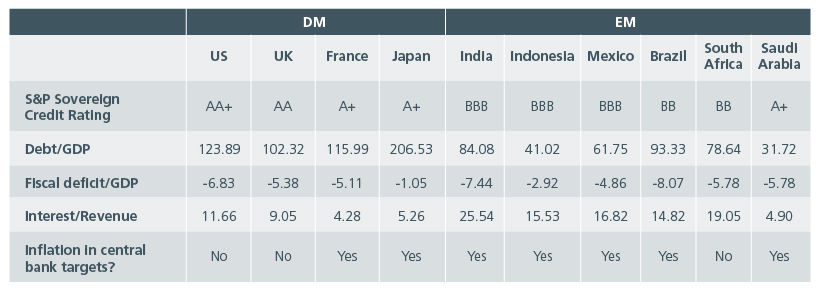
Over the years, many EM economies have lowered their debt burdens, improved their inflation credibility and strengthened their growth prospects. On the other hand, many DMs are increasingly weighed down by rising fiscal risk, inflation uncertainty and bond supply pressures. Fig. 1. As such, DM bonds may not always provide the same defensive role they have historically played in investor portfolios.
Fig. 1. Improving EM fundamentals is blurring the distinction between EM-DM
Source: Eastspring Investments, S&P Global Ratings, Bloomberg, respective Sovereign’s central bank website. Estimates as of 14 July 2025.
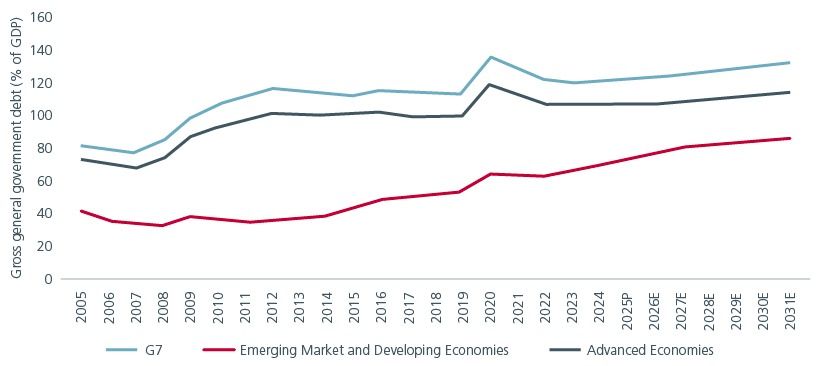
Lower debt burdens. Developed market yields have risen partly because of growing concerns over fiscal and debt sustainability. The International Monetary Fund expects G7 fiscal deficits to stay elevated and for their gross government debt to GDP ratio to rise significantly over the coming years as social and defense spending increases.
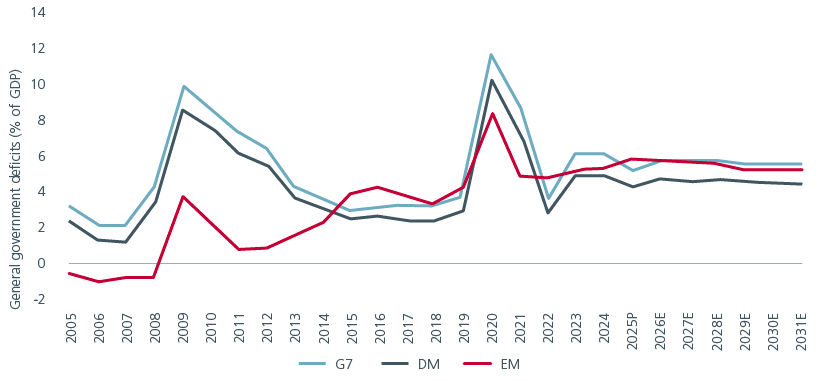
In contrast, EM governments, while not immune to fiscal pressures, are generally expected to remain less indebted than DMs. Some EM countries had pursued more measured post-pandemic fiscal support, which reduced inflation persistence, allowing central banks to regain policy flexibility earlier. Fig. 2 and 3.
Fig. 2. EMs’ fiscal deficit peaked at 8% of GDP post COVID
Source: Eastspring Investments, IMF World Economic Outlook, April 2026.
Fig. 3. EMs expected to be less indebted than DMs
Source: Eastspring Investments, IMF World Economic Outlook, April 2026.
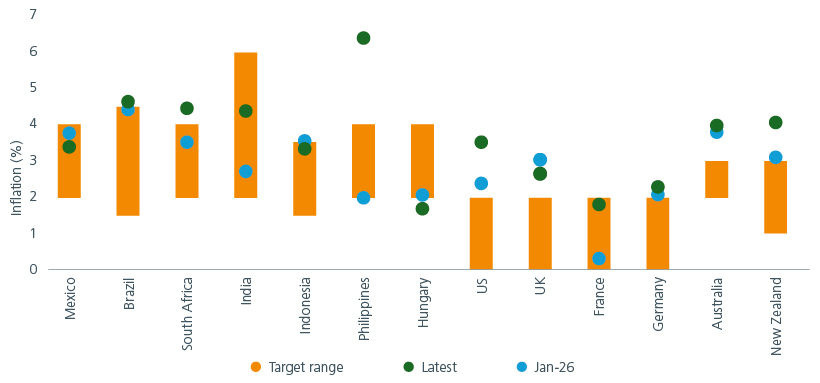
Improved inflation credibility. Although the Middle East conflict has added to inflationary pressures globally, the inflation rates across most major EMs remain within communicated central bank ranges except for selected economies which are more vulnerable to higher energy prices e.g. Philippines. Over the past years, several large EM central banks have also lowered/narrowed their inflation target ranges which have contributed to greater currency stability, making their local debt markets more attractive. On the other hand, inflation in several DMs is above target. DM’s larger fiscal needs and structurally higher social spending may also challenge the path to sustainably lower inflation. Fig. 4.
Fig. 4. Inflation across major EMs remain within central bank target ranges
Source and date: Eastspring Investments, Bloomberg, respective central bank websites. As of 22 July 2026.
Favourable growth prospects. EMs’ growth prospects are underpinned by favourable demographics, productivity catch-up, commodity endowments, manufacturing depth, digitalisation and regional reform stories. Over the next 5 years to 2031, EMs are expected to:
- Grow by an average of 2.4% p.a. faster than DM economies
- Generate almost 75% of nominal global growth
- Expand population 3x faster than DMs
- Drive majority of new global consumption and middle-class growth
- Gain market share in global manufacturing and trade
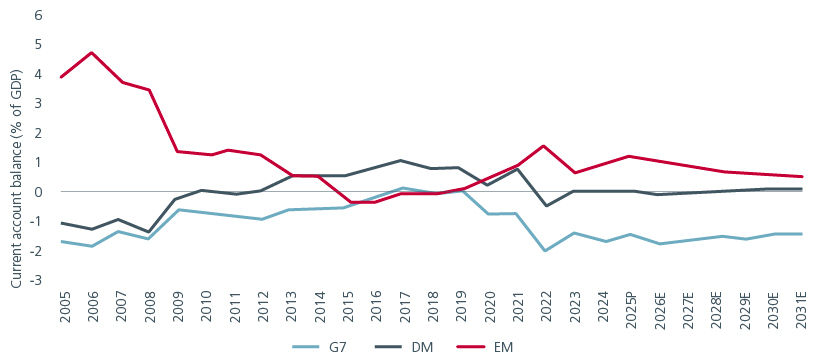
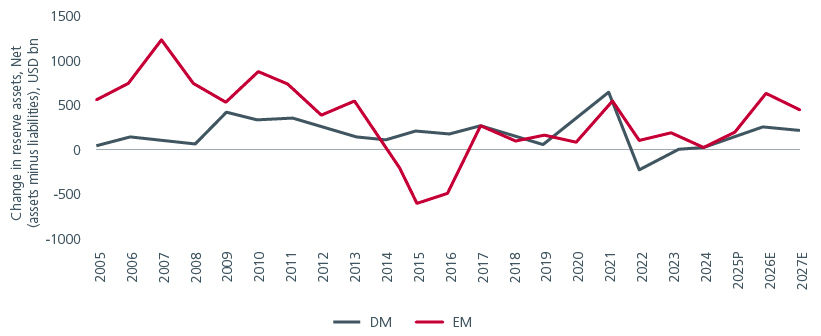
Improving growth prospects and rising exports have helped EMs’ current account balances and net reserve assets trend up since 2015. Fig. 5 and 6. On the other hand, the Group of 7 has increasingly exhibited signs of external imbalances.
Fig. 5. EMs’ current account balances have improved since 2015
Source: Eastspring Investments. IMF World Economic Outlook, April 2026.
Fig. 6. EMs’ net reserves have been rising since 2017
Source: Eastspring Investments. IMF World Economic Outlook, April 2026.
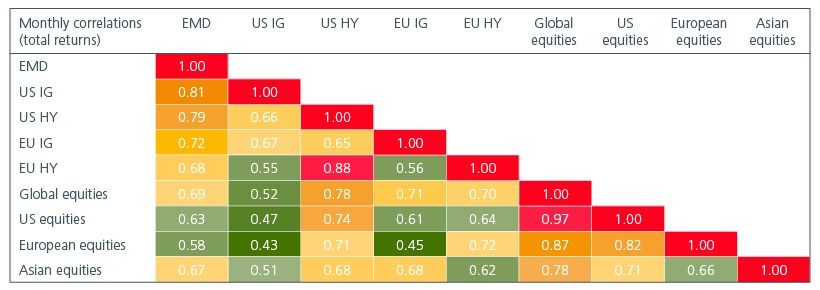
Greater diversification. EMs comprise of over 70 countries that are highly diverse in terms of economic structure, demographics and stages of development. As such, EMD is not dependent on one macro path and can offer greater portfolio diversification. Our analysis shows that EMBIGD returns have a weak correlation (0.32) with US Treasuries, and lower correlations with other major equity markets than comparable US and European High Yields. Fig. 7.
Fig. 7. EMD’s low correlations improve portfolio diversification
Source: Monthly correlations (total returns) – Jan 2006 – June 2026. Bloomberg. Eastspring Investments. JP Morgan EMBI Global Diversified Composite. Bloomberg US Corporate Bond Index. Bloomberg US Corporate High Yield Bond Index. Bloomberg Pan-European Aggregate Corporate Index. Bloomberg Pan-European High Yield Index. MSCI World. S&P 500 Index. MSCI Europe Index. MSCI AC Asia ex Japan Index.
Key takeaways
Reassess the EM-DM divide. Improving EM fundamentals and rising DM fiscal pressures are blurring the traditional distinctions between EMD and DM bonds.
Reframe EMD as a strategic complement to DM bonds. EMD can enhance income, provide access to a broader set of macro and credit opportunities as well as increase portfolio diversification.
Interesting reads










Singapore by Eastspring Investments (Singapore) Limited (UEN: 199407631H)
Australia (for wholesale clients only) by Eastspring Investments (Singapore) Limited (UEN: 199407631H), which is incorporated in Singapore, is exempt from the requirement to hold an Australian financial services licence and is licensed and regulated by the Monetary Authority of Singapore under Singapore laws which differ from Australian laws
Hong Kong by Eastspring Investments (Hong Kong) Limited and has not been reviewed by the Securities and Futures Commission of Hong Kong.
Indonesia by PT Eastspring Investments Indonesia, an investment manager that is licensed, registered and supervised by the Indonesia Financial Services Authority (OJK).
Malaysia by Eastspring Investments Berhad (200001028634/ 531241-U) and Eastspring Al-Wara’ Investments Berhad (200901017585 / 860682-K) and has not been reviewed by Securities Commission of Malaysia.
Thailand by Eastspring Asset Management (Thailand) Co., Ltd.
United States of America (for institutional clients only) by Eastspring Investments (Singapore) Limited (UEN: 199407631H), which is incorporated in Singapore and is registered with the U.S Securities and Exchange Commission as a registered investment adviser.
European Economic Area (for professional clients only) and Switzerland (for qualified investors only) by Eastspring Investments (Luxembourg) S.A., 26, Boulevard Royal, 2449 Luxembourg, Grand-Duchy of Luxembourg, registered with the Registre de Commerce et des Sociétés (Luxembourg), Register No B 173737.
Chile (for institutional clients only) by Eastspring Investments (Singapore) Limited (UEN: 199407631H), which is incorporated in Singapore and is licensed and regulated by the Monetary Authority of Singapore under Singapore laws which differ from Chilean laws.
The afore-mentioned entities are hereinafter collectively referred to as Eastspring Investments.
The views and opinions contained herein are those of the author, and may not necessarily represent views expressed or reflected in other Eastspring Investments’ communications. This document is solely for information purposes and does not have any regard to the specific investment objective, financial situation and/or particular needs of any specific persons who may receive this document. This document is not intended as an offer, a solicitation of offer or a recommendation, to deal in shares of securities or any financial instruments. It may not be published, circulated, reproduced or distributed without the prior written consent of Eastspring Investments. Reliance upon information in this document is at the sole discretion of the reader. Please carefully study the related information and/or consult your own professional adviser before investing.
Investment involves risks. Past performance of and the predictions, projections, or forecasts on the economy, securities markets or the economic trends of the markets are not necessarily indicative of the future or likely performance of Eastspring Investments or any of the funds managed by Eastspring Investments.
Information herein is believed to be reliable at time of publication. Data from third party sources may have been used in the preparation of this material and Eastspring Investments has not independently verified, validated or audited such data. Where lawfully permitted, Eastspring Investments does not warrant its completeness or accuracy and is not responsible for error of facts or opinion nor shall be liable for damages arising out of any person’s reliance upon this information. Any opinion or estimate contained in this document may subject to change without notice.
Eastspring Investments companies (excluding joint venture companies) are ultimately wholly owned/indirect subsidiaries of Prudential plc of the United Kingdom. Eastspring Investments companies (including joint venture companies) and Prudential plc are not affiliated in any manner with Prudential Financial, Inc., a company whose principal place of business is in the United States of America or with the Prudential Assurance Company Limited, a subsidiary of M&G plc (a company incorporated in the United Kingdom).
